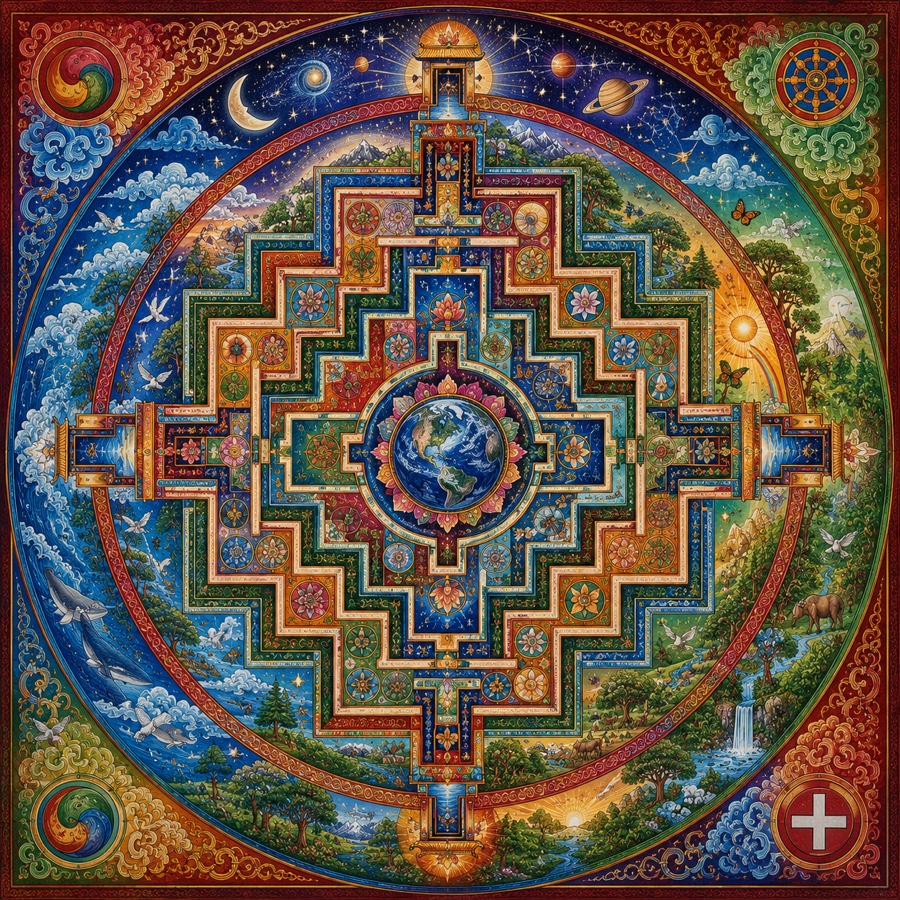
For Isaac and friends
Pith Drop
A month with the breath, the body, and the Jewel Tree
Pith — pith is a Tibetan teacher's word for the marrow of a teaching. GPS for the consciousness.
For Isaac, and his friends.
Before you beginListen first
A short note on the mantras
A mantra is a string of syllables in Sanskrit or Tibetan that doesn't translate cleanly into English. The sound itself is the point. You don't have to understand it. You let it run in the background while you sit, or you say it under your breath while you walk to class. It works on you sideways.
The ones below are from oceanofwisdom.org/mantras — free, traditional recordings. Find them by name on that page.
- Sherab Chamma — the Great Mother of Wisdom and Compassion. Closest English: the part of the universe that loves you no matter what.
- The Three Great Heart Mantras (Dharmakaya, Sambhogakaya, Nirmanakaya) — three layers of awakening: pure awareness, light, and form.
- The Five Elements Series — Earth, Water, Fire, Air, Space (and a combined one). One for each element your body is already made of.
- 100 Syllable Mantra — the long one. Said when you want to clean up after a hard day.
- Long Life Mantra — exactly what it sounds like.
- Sa Le O Mantra Music — the ambient/musical one. Good while walking.
For a sung version with English subtitles to learn from, see Geshe YongDong — Sherab Chamma Heart Mantra. For text, transliteration, and short commentary on the Three Heart Mantras, see Bön Mustang Australia — Three Heart Mantra. The teachings there flow from Geshe Sonam Gurung's lineage at Menri Monastery.
Week OneSit Like You Mean It
Posture is the whole game
Crown of the head lifted like a thread pulls it up. Shoulders down the back. Chin tucked a half-inch. Hands on the thighs. Tongue lightly on the roof of the mouth. Eyes soft, gaze on the floor a few feet ahead. Breath ordinary.
- Sit. Notice when you collapse. Come back. Done.
- One line in a notebook after: What did my body tell me today?
The Three Great Heart Mantras on oceanofwisdom.org/mantras. One a day, or all three. Let them run while you sit.
- Yongey Mingyur Rinpoche — Meditate by Letting Your Mind Be As It Is — 8 min. Tibetan, raised in Nepal, had panic attacks as a teen and meditated through them. The most teen-readable of the bunch.
- Mingyur Rinpoche — Guided Meditation on the Body, Space, and Awareness
- John Jackson — Tsa Lung Teaching — tsa lung is the Tibetan term for the channels and the inner winds. Plain-English intro to using the body to settle the mind.
- John Jackson — Guided External Tsa Lung Meditation — guided body practice you can follow along to.
- Tergar Meditation Community — Mingyur Rinpoche's org. Their free Joy of Living intro is excellent.
Noting feelings
On day five or six, try this on top of the basic sit. After you settle, bring attention to the body and notice what's there. As sensations arise, give each one a quiet one-word label: pleasant, unpleasant, neutral. Don't get into the story of the feeling. Just note it and watch it move.
After a few minutes, drop the labeling and let the mind run normally. Rest there. The point isn't to control what arises. It's to learn the difference between having a feeling and being had by it.
Week TwoGratitude, and the Word Refuge
Where you put your weight when the day breaks
Gratitude is specific. The cold water on my face this morning. My mom at dinner. The dog leaning against my leg.
Refuge is a Tibetan word for where you let your weight rest when nothing else holds you. The three traditional places — sometimes called the Three Jewels — are the awakened ones who walked this before you, the teachings they left, and the friends and teachers walking it now.
- Posture, three minutes.
- Three slow exhales. On each one, name one specific thing the day gave you.
- Once, silent or out loud: I take refuge in the awakened ones, in their teachings, in the friends walking this with me, and in the part of my own mind that already knows.
- Sit.
Sherab Chamma on oceanofwisdom.org/mantras. The mother of wisdom and compassion. Let her syllables hold the gratitude.
- John Jackson — Essential Teachings on Refuge and Bodhicitta, Part 1 — John is a Western Bön teacher and a student of H.H. Lungtog Tenpai Nyima, Yongdzin Tenzin Namdak, and Tenzin Wangyal Rinpoche. Plain-spoken, no incense-and-jargon delivery. This is exactly the topic of this week.
- John Jackson — Essential Teachings on Refuge and Bodhicitta, Part 3
- Tenzin Wangyal Rinpoche — Inner Refuge Prayer (with English subtitles) — short, melodic, sung by the lama himself.
- Tenzin Wangyal Rinpoche — Guided Meditation: The Practice of Inner Refuge
- Pema Chödrön — What If Uncertainty Is the Practice (Groundlessness) — what refuge feels like when nothing is solid.
- Dzongsar Khyentse Rinpoche — Right Intention, Part 1
Loving kindness phrases
Refuge runs both directions. After you say the refuge line and start to sit, try this: bring one person to mind and offer them a phrase. One person per day, rotating across the week.
It's the same phrase across the week. What changes is who you bring to mind. Pay attention to which days are easy and which aren't. That's the information.
Week ThreeThe Roots of the Tree
Meeting the Jewel Tree, slowly
The Jewel Tree is an old Tibetan visualization that Robert Thurman — a former monk under the Dalai Lama, Columbia professor, Uma's dad — brought into English. This week is the roots only. The trunk and branches wait until next week.
- Posture and breath, three minutes.
- Three exhales of gratitude. The refuge line, once.
- Eyes closed. Read once, then sit with it.
Imagine yourself sitting at the base of a huge tree. Its roots run deep beneath you — through soil, through stone, through every life that came before yours. Your grandparents. Their grandparents. The teachers who passed down what you're learning now. The strangers whose work and luck and grief made it possible for you to sit here. The roots are holding you. You didn't start from nothing. You inherited something.
Stay with the roots. Don't reach for the branches.
The Five Elements Series on oceanofwisdom.org/mantras — start with Earth. The element of the roots.
- Robert Thurman — Jewel Tree Meditation, Part 1 — filmed in Tibet.
- Robert Thurman — Jewel Tree Meditation, Part 2
- Robert Thurman — Full guided meditation under the Jewel Tree of Tibet
- The book / full audio retreat: The Jewel Tree of Tibet — Sounds True — also free at the Internet Archive.
Forgiveness phrases
Roots are also where harm lives. Inherited harm, harm given, harm received. If you want to work with that, the practice is three phrases, said slowly, with whoever or whatever comes to mind:
- Forgive me (for the harm I have caused, knowingly or unknowingly)
- I forgive you (for the harm caused to me, knowingly or unknowingly)
- I forgive myself
Forgiving is not forgetting. It is not letting harmful people back in. It is unclamping the energy that gets stuck around old moments so it can be used somewhere else.
Week FourThe Whole Tree
Branches, leaves, light
This week, the full visualization. The script is yours — ancestors weaving the tapestry, branches cradling the wisdom keepers, your loved ones nested in the leaves with their faces blurred but their joy clear.
- Posture, breath, gratitude, refuge — about five minutes total.
- The Jewel Tree, full:
- Roots into the ancestors.
- Trunk holding you up.
- Branches above, cradling teachers, lineage holders, beings of wisdom you may not have names for yet.
- Leaves all around, where your loved ones and every living being rest, content, smiling toward you.
- Light falling from the whole tree onto your crown like slow rain, soaking in.
- Draw the whole image inward to the heart. Let it imprint.
- Rest in what's left when the image fades.
Cycle through the Five Elements combined recording, the 100 Syllable Mantra, and Sa Le O while you sit. Or just Sherab Chamma again. Whichever stays with you.
What does the tree know about me that I didn't know thirty days ago?
- Yongey Mingyur Rinpoche — In Love with the World playlist — clips from when he walked out of his monastery at 36 and wandered Nepal and India as a homeless monk for four and a half years. Teen-readable book of the same name.
- Mingyur Rinpoche — Obstacles Become Opportunities
- Wandering… But Not Lost documentary site
- The Dalai Lama — Compassion Meditation at Emory
- Garchen Buddhist Institute — on bodhicitta and tonglen (giving and taking on the breath).
- John Jackson — YZL Chat: a Meditation / Bön Teacher Conversation — long-form, good for the end of the month when you want to hear someone Western talk about all of this in normal English.
Lion's gaze, and the diamond
When you throw a ball to a dog, it chases the ball. When you throw a ball to a lion, it keeps its gaze on you.
At the end of the Jewel Tree sit this week, before you draw the image inward, try this: open your eyes. Look ahead, gently, not focused on anything. Let thoughts come and go. Don't chase them. Picture your mind as open space, clear and bright like the sky.
Then close the eyes again. Bring together all the light of the practice into a small clear diamond at the crown of your head. Breath by breath, draw the diamond down into the heart. The whole month settles there. Rest in that for as long as you can.
A little history, for the curious
If you want to know where these practices come from — what Bön actually is, how Tibetan Buddhism met it, how all of it crossed the Himalayas into Nepal and now into your phone — start here:
- Lion's Roar Podcast #130 — Tibet's Indigenous Religion (with Harvey Rice and Jackie Cole) — interview about Bön and why its earth-centered spirituality still matters.
- Gyalshen Institute — A Brief History of Bön — short, readable.
- Gyalshen Institute — Yungdrung Bön — deeper history.
- Ligmincha — Bön Buddhism — Tenzin Wangyal Rinpoche's center's introduction.
Books to read alongside
Three books to pick up if anything in the practice catches you. Read one, not all three. They each go in a different direction.
How to use it
- Same time, same spot. Body learns the room before the mind learns the practice.
- Doing it with friends — text each other one sentence at the end. Not did you sit? but what did the body tell you? The sentence is the practice's afterimage.
- Mantra in the background is fine; lyrics in English aren't. Lyrics pull the mind sideways. Tibetan syllables don't.
Channels and sites to follow
- oceanofwisdom.org/mantras — the mantra library.
- Gyalshen Institute — Ngöndro (Preliminary Practices) — Chaphur Rinpoche's Bön center; full ngöndro with Tibetan text, transliteration, English, and audio for refuge, bodhicitta, the Three Heart Mantras, and the 100 Syllable Mantra.
- shedrub.org — Chökyi Nyima Rinpoche's online home (Kagyu / Nyingma); his seat is Ka-Nying Shedrub Ling monastery in Kathmandu.
- Yongey Mingyur Rinpoche and Tergar Meditation Community.
- Ligmincha International (Tenzin Wangyal Rinpoche).
- Siddhartha's Intent (Dzongsar Khyentse Rinpoche).
- John Jackson on YouTube — and his Three Jewels Coaching site, plus his Ligmincha biography.
- The Dalai Lama, official.
- Pema Chödrön Foundation.
- Tara Mandala — Lama Tsultrim Allione.
- Bön Mustang Australia — Three Heart Mantra — affiliated with Geshe Sonam Gurung's lineage from Menri Monastery.
- Garchen Buddhist Institute.
If this is yours now
The next thing is a daily room. I keep mine at Keep Practice — a daily journal connected to the lunar cycle, the seven tantric deities, and the dedication. For anyone who has begun, and wants to keep going.
keeppractice.org